
Loretta Pettway Bennett
Loretta Pettway Bennett grew up learning quilting from the women in her family. She traveled the world with her husband, a veteran who did three tours in the armed forces, and during that time she did some quilting, but it was when she visited the Museum of Fine Arts, Houston to see the Quilts of Gee’s Bend exhibition that she really began thinking of quilting as fine art. Loretta is the sister-in-law of Marlene Bennett Jones, and together they host Vacations with an Artist, an opportunity for quilters from all over the world to learn about the quilting traditions of Gee’s Bend.
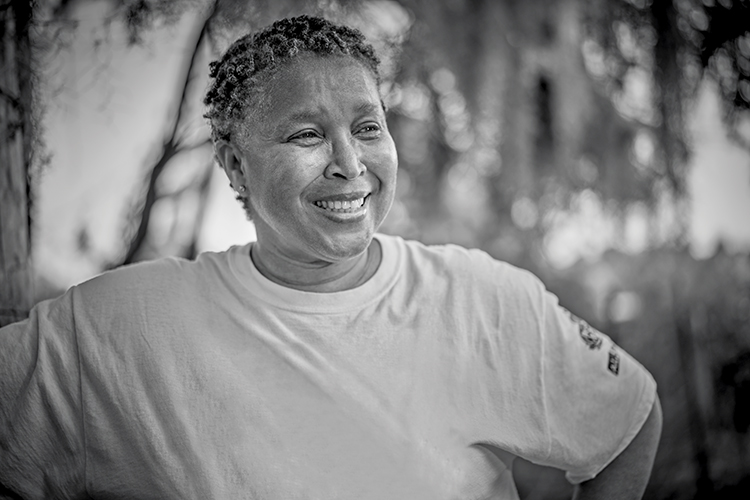
Like most who grew up here in Gee’s Bend, I started when I was a child. My early memory is from when I was about 5 or 6 years old, when my mom used to have us threading needles for them. That’s how they kept us busy and inside so they could see where we were. And I started even from then, picking up little pieces, trying to sew it like the women did. I think I started loving it because at the age of about 12, that’s when I made my very first quilt. It was around 1972 or 1973, and it was a flower garden pattern, a very complicated quilt for a 12-year-old. I have always been that way. I love challenging myself. If I see it, I think I can make it. I made my first double wedding ring quilt in the 90s, when I was 30-something.
I got married at 18 to Marlene’s brother. He was in the army, stationed over in Germany. When I went over there, of course, there wasn’t a whole lot to do. We were in a remote area, kind of like Gee’s Bend, where you only get one or two channels on TV, and they were all German. So, what do I do? I started making a flower garden quilt. And I still have that one. It’s in the Nicelle Beauchene Gallery in New York.
At that point, I was still into pattern quilts because that’s all I ever knew. After we came back stateside, we were in El Paso, Texas for two years. I was kind of dabbling in clothes, making little shirts for my older son and dresses and skirts for myself. After two years, we were shipped back to Germany. I made a few quilts on and off, small things. And then back to El Paso again. So, I wasn’t making big quilts, I was making smaller things like baby quilts.
There was one that I made when I was in high school. Me and some girls from here in Gee’s Bend, we made our home economics teacher a quilt for her first grandchild. It was by a pattern also. It had a clothesline with baby clothes, and it had the sun on it, with an appliqué bird on a fence. I think I was 15 at the time. So, I made a pattern of that quilt. I kept that pattern, and I guess I made close to 100 quilts like that. And I would make the little overalls different, the little dresses on there for the girl.
At first, coming out of high school, seeing the women here, that’s what they did mostly, pattern quilts. I know we had some quilts that were abstract, that they made using what they had, because they couldn’t afford to buy material. But in the late 1990s, that’s when all the buzz was going on. My mom had a Pine Burr piece on her chair, and I would see her working on it every time I came home. So, I asked her if I could take it back with me to see if I could make one. By this time, my husband had left the military, and we were in North Alabama. I figured out how to make it and from that I got a grant, and I made a Pine Burr quilt for the state of Alabama. We donated it a few years later to the state. (The state of Alabama is the only one to have a designated state quilt, and the Pine Burr pattern was chosen to honor the Black women of the Freedom Quilting Bee and their contribution to the Civil Rights Movement.)
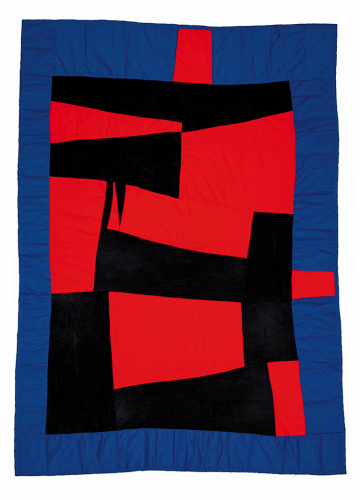
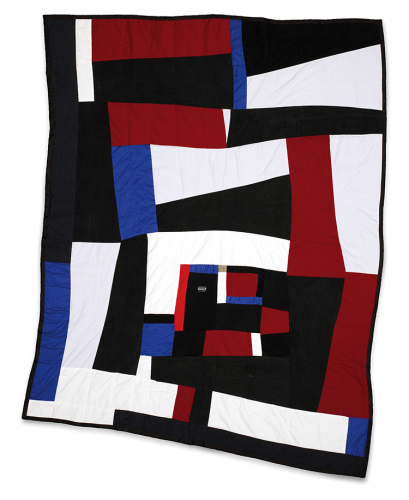
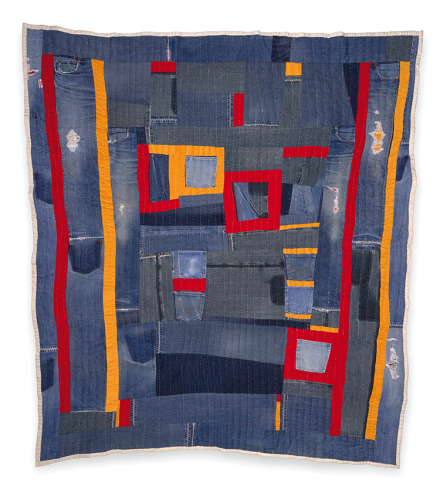
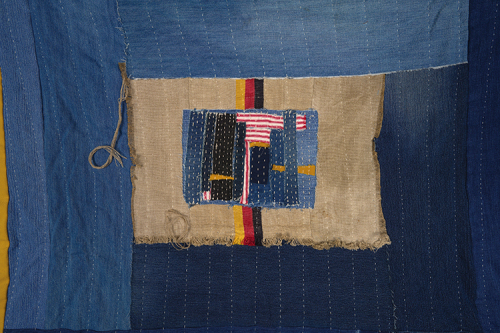
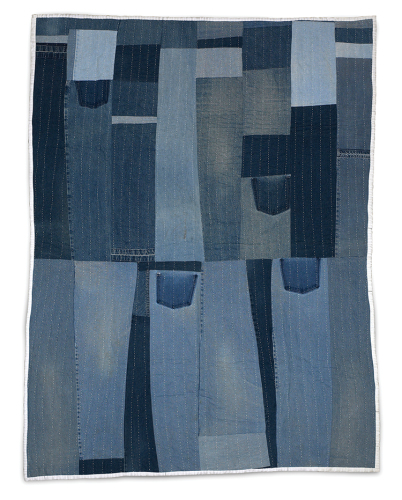
I went to the first exhibition in Houston, and I was blown away, because the quilt that my mom had in the show, I could remember lying on that quilt. It was on the floor in our house. I left there thinking, would I ever be able to have my quilt hanging up in a museum? That’s when I started thinking about more abstract patterns.
I always wanted to be a painter. I used to buy the little paint-by-numbers kits, and I loved doing that. I started sketching and I would collect the clothing, and color the sketch with the fabric that I had. And that’s how I got into the more abstract designs. After I got into it, I said, well, I can’t paint, but I can paint with cloth.
I collect the fabric and then I set it all up or tear it all up, and then I start laying it out. Even if you make blocks, you always start in the center and work your way out until you have your finished piece. And that may be because you only have a certain amount, so that’s when you stop. It’s almost like building a house. You have to lay the foundation.
I use a lot of work clothes. And usually, I’m repurposing things, sheets and curtains, tablecloth, old pieces of fabric that someone had in their sewing stash, and they may have passed and someone donated it. Some of the quilts you may see a small pocket, those are my son’s jeans.
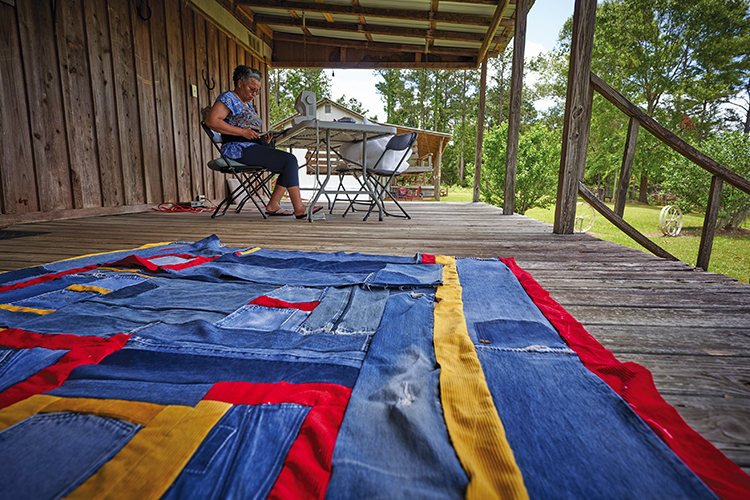
Our quilts, you’re not going to find them perfectly squared off. Some of that is due to the clothing or even the fabric itself, because we do a lot of tearing. And in the stitching, you’re not going to find 12 stitches within an inch. Most times we use white thread, and that is another defining mark of the Gee’s Bend quilts.
There are some younger ones coming along, learning the traditions. And for the last three years, on Juneteenth, we’ve been doing a workshop for the younger ones here. Hopefully, we’ll pass the tradition on, maybe not to all, but one or two may come out of there. I’m very positive about it continuing.